Understanding Ontario's No-Fault Insurance System for Auto Accidents in Toronto and How Benjamin Law Firm Can Assist You

Auto accidents can occur at any time and place, and Toronto is no exception. With its bustling streets and heavy traffic, car accidents in Toronto are a common occurrence. In such situations, understanding Ontario's no-fault insurance system becomes crucial. This blog post aims to shed light on the intricacies of Ontario's no-fault insurance system and introduce you to Benjamin Law Firm, a trusted ally for navigating the complexities of auto accident claims in Toronto.


Ontario's No-Fault Insurance System Demystified

Ontario operates under a no-fault insurance system for auto accidents. This system is designed to provide accident victims with quick access to medical care and financial support, regardless of who is at fault for the accident. Here are the key components of Ontario's no-fault insurance system:


  • Direct Compensation - Property Damage (DC-PD): Under this component, if your vehicle sustains damage in an accident, your own insurance company will compensate you for the damage, provided you were not at fault for the accident.


  • Accident Benefits: Accident benefits cover medical and rehabilitation expenses, as well as income replacement if you are unable to work due to injuries sustained in the accident. These benefits are available to you irrespective of fault and are provided by your own insurance company.


  • Third-Party Liability: If you are at fault for the accident and someone else suffers injuries or property damage, your insurance company will step in to provide coverage to the injured party. This is where personal injury claims may come into play.


  • Tort System: In some cases, when injuries are severe or meet specific criteria, accident victims may be allowed to file a lawsuit against the at-fault party for additional compensation beyond accident benefits. This is known as the tort system.


How Benjamin Law Firm Can Be Your Partner in These Difficult Times

Navigating Ontario's no-fault insurance system and dealing with the aftermath of an auto accident can be overwhelming. Benjamin Law Firm, available at www.benjaminlaw.ca, is a leading personal injury law firm in Toronto with a specialization in helping accident victims understand their rights and secure the compensation they deserve. Here's how Benjamin Law Firm can assist you:


  • Expertise in Ontario's No-Fault Insurance System: The team at Benjamin Law Firm possesses a deep understanding of Ontario's no-fault insurance system, including its intricacies and nuances. They can guide you through the claims process and ensure you access the maximum benefits available to you.


  • Personalized Legal Representation: Recognizing that every auto accident case is unique, Benjamin Law Firm provides personalized legal representation tailored to your specific circumstances. Whether you're grappling with property damage, mounting medical bills, or lost wages, they will work diligently to protect your rights and interests.


  • Handling Insurance Companies: Dealing with insurance companies can be a daunting and intimidating task. Benjamin Law Firm has the experience and expertise to negotiate with insurance companies on your behalf, ensuring you're treated fairly and receive just compensation.


  • Pursuing Tort Claims: In cases where the injuries are severe and meet the criteria for a tort claim, Benjamin Law Firm can assist you in pursuing legal action against the at-fault party. They will build a robust case to seek additional compensation for your pain and suffering, future medical expenses, and other damages.


  • Compassionate and Supportive Approach: Benjamin Law Firm understands the emotional and physical toll that auto accidents can take on individuals and their families. They offer compassionate and supportive legal counsel, helping you navigate the emotional challenges that come with recovering from an accident.


  • Free Consultation: If you're uncertain about whether you have a valid claim or how to proceed after an accident, Benjamin Law Firm offers a free consultation. This initial discussion allows you to seek legal advice without any financial commitment.


Understanding Ontario's No-Fault Insurance System

Now, let's delve deeper into the key aspects of Ontario's no-fault insurance system:

  • Direct Compensation - Property Damage (DC-PD): This component ensures that your own insurance company will compensate you for the damage to your vehicle if you were not at fault for the accident. It is a critical feature of the system, as it allows for the prompt repair or replacement of your vehicle without the need to establish fault.


  • Accident Benefits: Accident benefits are designed to provide immediate financial assistance to accident victims. They cover medical and rehabilitation expenses, income replacement, and other essential costs incurred due to injuries sustained in the accident. It's important to note that these benefits are available regardless of fault and are provided by your own insurance company.


  • Third-Party Liability: If you are deemed at fault for the accident and someone else has suffered injuries or property damage, your insurance company will step in to provide coverage to the injured party. This aspect of the system ensures that innocent victims are not left without recourse and receive the compensation they need.


  • Tort System: In cases where the injuries are severe and meet specific criteria, accident victims may have the option to file a lawsuit against the at-fault party for additional compensation beyond the accident benefits. This is where the tort system comes into play, allowing individuals to seek compensation for pain and suffering, future medical expenses, and other non-economic damages.


Conclusion

Auto accidents can have far-reaching consequences, and understanding Ontario's no-fault insurance system is vital when dealing with the aftermath of an accident in Toronto. Benjamin Law Firm, available at www.benjaminlaw.ca, is your trusted partner in helping you navigate the complexities of the system and ensuring that your rights and interests are protected. If you find yourself in the unfortunate situation of being involved in an auto accident in Toronto, don't hesitate to seek legal guidance and support from Benjamin Law Firm. Their experienced team is dedicated to assisting you as you move towards recovery and resolution in these challenging times.

Greater Toronto Area's Trusted Personal Injury Law Firm

March 17, 2026
Greater Toronto Area’s Premier Family-First Law Firm Protecting Families, Securing Futures, and Restoring Justice. The Invisible Burden of Personal Injury In the Greater Toronto Area (GTA), over 220,000 Canadians are hospitalized annually due to injuries sustained at home, in public spaces, or on the roads. Whether it is a sudden automobile accident on the 401 or a slip and fall on icy public property, these events represent major turning points in the lives of victims and their families. At Benjamin Law, we understand that an injury is more than just a physical ache; it is a psychological and financial hardship that can derail your future. Our Founding Partner, Anthony Stephen Benjamin, established this practice with a core belief: every person deserves proper representation. Having worked with the Financial Services Commission and the Attorney General of Ontario, Anthony saw firsthand how insurance companies can intimidate claimants. Today, with over 10 years of experience and 3,500 families helped, our mission remains the same: to ensure you are treated fairly. To achieve this, we utilize an education-first approach. The most powerful tool in our arsenal—and yours—is medical evidence. This blog post explores how documented medical proof transforms a "he-said, she-said" dispute into a successful personal injury claim. Why Medical Evidence is the Cornerstone of Your Claim When you file a personal injury claim in Ontario, the burden of proof rests on your shoulders. You must demonstrate not only that the other party was negligent but also that their negligence directly caused your specific injuries. Without objective medical evidence, even the most severe injuries can be dismissed by insurance adjusters as "pre-existing" or "exaggerated." Establishing Causation Medical evidence provides a timeline that links the accident to your physical or psychological condition. If you visit a doctor immediately after a car accident, the records created that day serve as a "snapshot" of your health. This prevents the insurance company from arguing that your back pain was caused by something else that happened days or weeks later. Quantifying the Impact Personal injuries are categorized as physical (broken bones, spinal cord injuries) or psychological (PTSD, anxiety, work-related stress). Medical evidence allows us to put a value on these "invisible" injuries. Diagnostic tools such as MRIs, CT scans, and psychological evaluations provide the data needed to quantify your pain and suffering. Key Types of Medical Evidence That Strengthen Your Case At Benjamin Law, our family-first litigation team has over 60 years of collective experience. we know exactly which pieces of evidence carry the most weight in the complex world of personal injury law. 1. Immediate Medical Records and ER Reports The records from your first visit to the hospital or family doctor are vital. They contain "contemporaneous notes"—observations made by medical professionals at the time of the injury. These reports document your initial complaints, the visible signs of trauma, and the immediate treatment provided. 2. Specialist Reports and Expert Testimony For complex injuries like Traumatic Brain Injuries (TBI) or Spinal Cord Injuries, a general practitioner’s note is often not enough. We work with neurologists, orthopaedic surgeons, and occupational therapists to provide expert opinions. These specialists can testify about the long-term prognosis of your injury and whether you will require lifelong care or specialized equipment. 3. Imaging and Diagnostic Results Nothing is more persuasive to a jury or an insurance adjuster than visual proof. X-rays: To prove fractures and bone damage. MRIs/CT Scans: To reveal soft tissue damage, herniated discs, and internal brain trauma. EMGs: To document nerve damage and muscle function loss. 4. Treatment Journals and Therapy Notes Physical therapy and rehabilitation records show your "effort to mitigate." In Ontario, you have a duty to try to get better. Consistent attendance at therapy sessions—documented by therapist notes—proves that you are taking your recovery seriously and provides a daily log of your pain levels and physical limitations. The Role of Psychological Evidence Injuries aren't always visible. Many GTA families suffer from the psychological aftermath of an accident. Whether it is the trauma following a dog bite or the depression resulting from a chronic work-related injury, non-physical injuries are just as valid under the law. Psychological evaluations and ongoing counseling records are essential for claiming damages for mental anguish. At Benjamin Law, we guide our clients through the process of securing these assessments, ensuring that the "whole person"—not just the physical body—is represented in the claim. Mitigating Financial Risk Through Step-by-Step Guidance One reason Benjamin Law is one of the most trusted firms in the GTA is our commitment to mitigating the financial risks that occur during litigation. We understand that while your case is pending, the bills don't stop. Long-Term Disability (LTD) Claims If your injury prevents you from working, we assist in coordinating your personal injury claim with your Long-Term Disability benefits. Medical evidence is the bridge between these two. The same doctor's report that proves the driver was at fault for your accident can also serve as the proof required by your disability insurer to show you are "totally disabled" from working. Fighting the "Insurance Gap" Anthony Stephen Benjamin founded this firm because he saw a gap in how insurance companies treated claimants. Insurance adjusters are trained to find inconsistencies in medical records to deny or reduce settlements. Our team meticulously reviews your medical file to ensure that every symptom is documented consistently, closing the gap that insurers use to avoid paying what you deserve. Justice Through Preparation In the complex world of personal injury law, success is found in the details. You shouldn't have to bear the financial burden of an accident that wasn't your fault. By leveraging comprehensive medical evidence, we transform your experience into a factual, undeniable legal argument for compensation. At Benjamin Law, we bring deep industry knowledge and breakthrough insights to every case. Whether you have suffered a physical injury from a motorcycle accident or a psychological illness from work-related stress, our team is ready to help you recover the compensation you deserve. We have recovered over $60 million for our clients because we work hard, fast, and strategically. Don't let your recovery be a matter of chance. Rely on the firm that puts families first.
February 6, 2026
Losing your job is one of the most stressful life events a person can experience. Beyond the emotional toll, the immediate concern is financial: How will I pay my mortgage? How long will it take to find a new role? At Benjamin Law, the Greater Toronto Area's premier family-first law firm, we understand these anxieties. Founded by Anthony Stephen Benjamin, our firm has spent 30 years helping over 3,500 families navigate complex legal worlds, recovering more than $60 million in the process. If you’ve been "fired for no reason" (terminated without cause), you are likely entitled to a severance package. However, there is a massive difference between what your employer offers and what the law actually requires . This guide explains how severance is calculated in Ontario and how to ensure you aren't leaving money on the table. The Two Levels of Severance: ESA vs. Common Law In Ontario, severance isn't just one thing. Your legal entitlement is governed by two different frameworks. Most employers will offer you the bare minimum required by the first, hoping you don't know about the second. 1. Statutory Minimums (The Employment Standards Act) The Employment Standards Act (ESA) sets the "floor." These are the absolute minimums an employer must pay. It consists of two parts: Termination Pay: Generally one week of pay per year of service, capped at 8 weeks . Severance Pay (ESA): This is only for "long-service" employees (5+ years) where the employer has a global payroll of at least $2.5 million. It is also one week per year, capped at 26 weeks . 2. Common Law Reasonable Notice This is where the "Premier Family-First" expertise of Benjamin Law comes into play. Unless you have a bulletproof, legally enforceable contract that says otherwise, you are entitled to Common Law Reasonable Notice . This is the amount a judge would award you if your case went to court. Under common law, there is no "one week per year" rule. Instead, the "maximum" can be as high as 24 months of pay . For most non-unionized employees, common law notice is significantly higher than the ESA minimums. The Bardal Factors: How Judges Calculate Your Worth In 1960, the landmark case Bardal v. Globe & Mail Ltd. established four key factors that Ontario courts use to determine your "reasonable notice" period. Think of these as the scales of justice for your career. Length of Service The longer you have dedicated your life to a company, the more the law protects you. Long-tenured employees are seen as being more "dependent" on their specific employer, justified by their years of loyalty. Age of the Employee The law recognizes the reality of the 2026 job market: it is often harder for a 55-year-old executive to find a comparable role than it is for a 25-year-old junior associate. As you age, your severance entitlement typically increases. Character of Employment This refers to your level of responsibility and specialization. Senior managers, directors, and highly specialized technical experts usually receive longer notice periods because there are fewer "comparable" jobs available to them. Availability of Similar Employment If you work in a niche industry or if the economy is currently in a downturn for your specific sector, the courts may award a higher settlement to provide a longer "financial bridge" while you search for work. Don't Forget the "Hidden" Compensation Many people make the mistake of calculating severance based solely on their base salary. At Benjamin Law, we look at your Total Compensation. A true legal settlement should account for: Benefits: The value of your health, dental, and life insurance. Bonuses: Any non-discretionary or historical bonuses you would have earned during the notice period. Car Allowances & Perks: If the company paid for your phone or car, that value must be replaced. Pension/RRSP Contributions: Employer matches are part of your earnings. Is Your Termination Clause Enforceable? Your employer may point to a "termination clause" in your contract to justify a small offer. However, Ontario courts are notoriously strict. If that clause is even slightly ambiguous or fails to meet the updated 2026 standards of the ESA, it may be found void and unenforceable. If the clause is thrown out, you automatically default to the much higher common law standards. Important Note: Never sign a severance offer or release on the spot. Employers often set "exploding deadlines" to pressure you into accepting less than you are worth. Take Control of Your Transition You are valued at Benjamin Law. Whether your case is resolved through a simple demand letter or requires more dedicated advocacy, our primary motivation is your success. We believe every person should be properly represented and treated fairly by insurance companies and large employers alike. Don't guess what your future is worth. We have built a tool specifically to help you understand the gap between an employer's offer and your true legal rights. Check Your Entitlement Now Use our Ontario Reasonable Notice & Severance Pay Calculator to get an instant estimate of your potential settlement. 
January 6, 2026
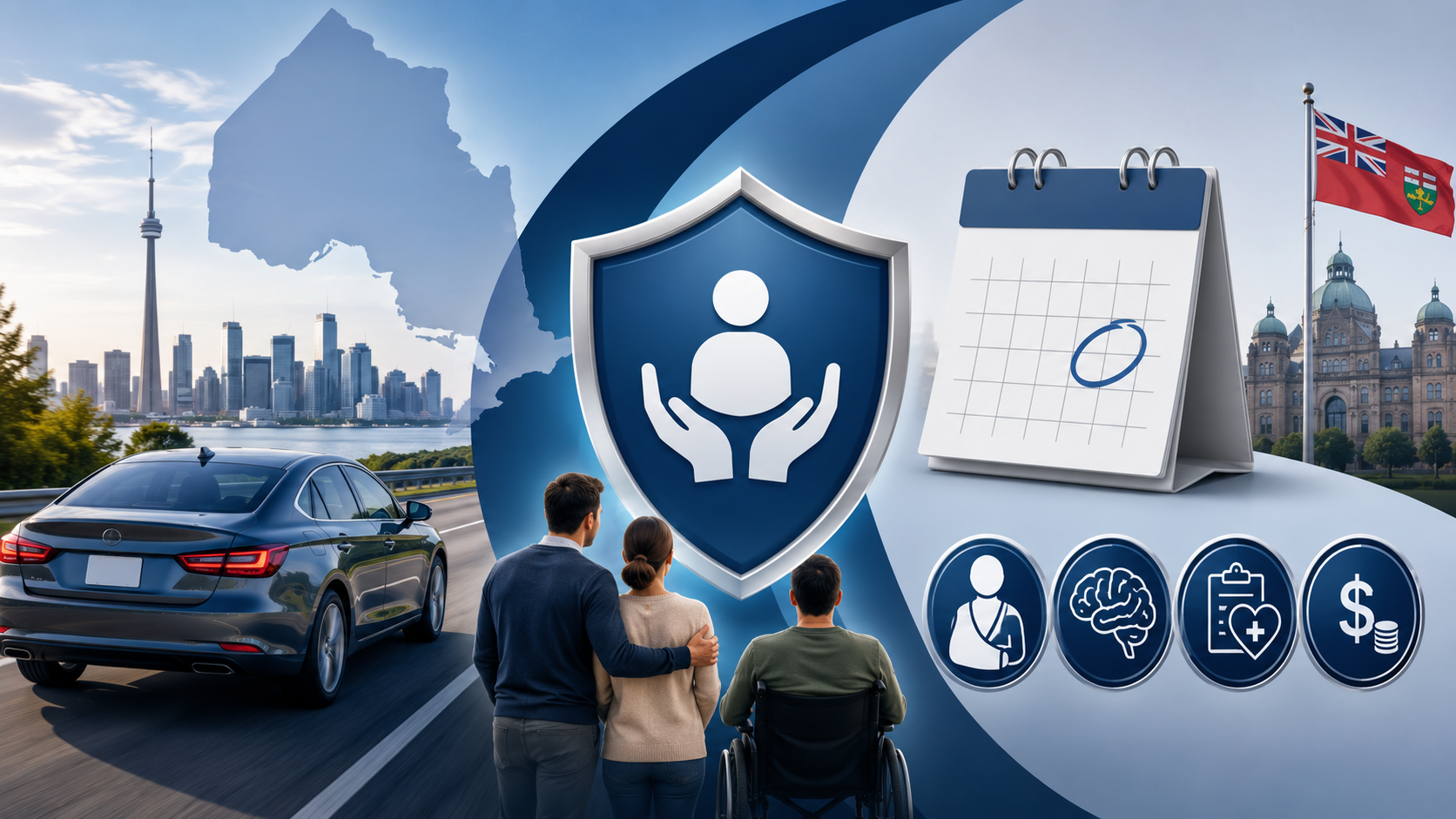
As we kick off a new year, many of us are setting goals for a safer, more organized year ahead. However, even with the best resolutions, auto accidents can occur at any time. With Toronto’s bustling streets and the unpredictable driving conditions that often arrive with the turn of the calendar, car accidents remain a common occurrence. In 2026, understanding Ontario's no-fault insurance system is more crucial than ever. This post aims to demystify the system and introduce you to Benjamin Law Firm, your trusted ally for navigating auto accident claims in the city. Ontario's No-Fault Insurance System Demystified Despite the name, "no-fault" doesn't mean no one is responsible. Instead, it means that if you are injured or your vehicle is damaged, you deal with your own insurance company for immediate support, regardless of who caused the accident. This ensures victims get quick access to care. The Key Components: Direct Compensation - Property Damage (DC-PD): If your vehicle is damaged and you aren't at fault, your own insurer pays for the repairs. Accident Benefits: These cover medical rehabilitation and income replacement if you can’t work. These are available to everyone, regardless of who caused the crash. Third-Party Liability: If you are found at fault, your insurance provides coverage for the other party’s injuries or property damage. The Tort System: For severe injuries, victims can sue the at-fault driver for additional compensation (like pain and suffering) beyond standard benefits. How Benjamin Law Firm Can Protect You This Year Navigating the aftermath of a collision can be an overwhelming way to start your year. Benjamin Law Firm specializes in helping Toronto residents secure the compensation they deserve. Expert Guidance: We understand the nuances of the Ontario insurance landscape and ensure you access the maximum benefits available. Handling Insurance Adjusters: Dealing with insurers can be intimidating. We take over the negotiations so you can focus on your recovery. Pursuing Tort Claims: If your injuries meet the legal threshold, we build a robust case to seek damages for future medical expenses and loss of enjoyment of life. Compassionate Support: We recognize the physical and emotional toll an accident takes. We provide a supportive environment for you and your family during these challenging times. Start the year with peace of mind. Benjamin Law Firm offers free consultations to help you understand your rights with no financial commitment. A new year brings new opportunities, but it also brings the reality of Toronto traffic and winter hazards. If you find yourself involved in an accident, don't navigate the legal hurdles alone. Visit www.benjaminlaw.ca today to ensure your rights are protected as you move toward recovery and resolution.

BOOK YOUR FREE CONSULTATION


Fill out the Case Evaluator form below to discuss your case or claim with one of our experienced Family-First legal professionals. At Benjamin Law, we work hard, and fast to get you justice, to solve your problems, and get you the compensation that you deserve.

Contact Us